
5 questions with Jeff Van Dreason
The founder of EAR•WAX, a new magazine for music and audiodrama, shares his hottest take
There’s a severe lack of audiodrama criticism. And to be clear, I don’t mean randos on Reddit going “your podcast sucks.” There are plenty of those. I mean people thinking and writing about audiodrama as a medium. It’s not just, “Is this show any good?” It’s “What is this show doing artistically? Does it succeed? What is the cultural context of this work?” Real in-the-moment analysis that help shape our perceptions of a medium.
The role of the critic is much maligned in popular culture—see Ratatouille, Charli xcx’s baby tee, the phrase “let people enjoy things.” But I’d say it’s easy to feel maligned by critics when your medium actually has critics to begin with. While there are a few excellent bloggers out there reviewing audiodrama, it’s nowhere near the level of movies, music, or books (even as professional criticism is dwindling there, too).
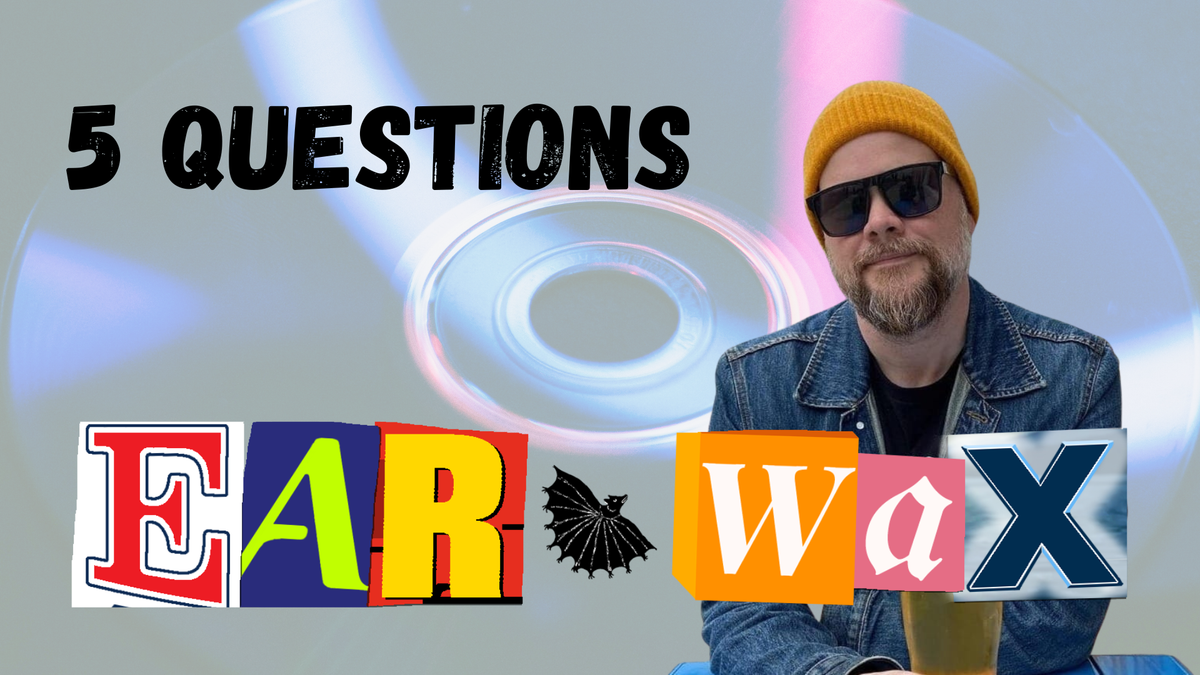
Jeff Van Dreason wants to change that. EAR•WAX Magazine, launching this month, is a newsletter and podcast dedicated to all things sound. Music, indie audio fiction, found sounds, field recordings, poetry and prose, that weird noise your wrist makes sometimes after you sleep on it wrong.
Jeff is the perfect guy to launch this. Co-creator of indie darling Greater Boston, creator of the audiodrama concept album The Perfect Sentence, and all-around thinker about all things community. He’s enlisted a crew of podcasters and writers—including yours truly, ahem—to help launch EAR•WAX.
I implore you subscribe to the newsletter and check out issue number one today, featuring a piece from me on Robyn's “Sexistential,” an interview with The Bright Sessions creator Lauren Shippen, and an editorial against AI in music and audiodrama creation.
While Jeff has been extremely busy in the run-up to launching EAR•WAX, he took some time to answer five questions for us about audiodrama, sound effects, and nesting folders.
How would you describe yourself to a stranger at a party?
Depending on the context of the party, it could be one of the following options:
1). “Nora’s Dad / Caitlin’s husband,”
2). “I work in higher education in the areas of assessment and data, but I’m also an English and Humanities instructor and was a faculty member for 15 years before transitioning to administration.”
3). “I’m a writer, podcaster, sound designer, producer, wannabe novelist and all around weirdo.”
How do you organize your files?
Folders. Folders like Russian Dolls. So many folders. That said, I don’t have a file naming style unless I’m creating files for my audio fiction. And I don’t use the words “final draft” in the file name of the file until it really is the final draft. There are too many files with “FINAL_DRAFT_FOR_REAL_THIS_TIME.RPR” in my directory so I’ve learned it’s bad luck to call it final until it’s really final.
What was the first audiodrama you fell in love with?
In college I directed, co-wrote, and produced a stage version of The Lost World (BBC Radio 4). We did live foley for it on stage, but presented it like it was set in a ‘40s radio station, with a wraparound plot that intersected with the Lost World “show,” as voice actors, foley artists, and assistants all scrambled to pull off the production despite all sorts of farcical hijinks. The audiodrama was far from unique, but it was so much fun to pull off the sound effects and create a story within an already existing story—and it gave me an idea of what was possible with audio, especially using sound in a live setting. We had a blast making it and we actually were asked to restage it later in the year.
Describe your favorite sound effect.
It has to be the Wilhelm Scream. I just love how identifiable it is and how widely used it is. I was doing research on it the other day and was so thrilled to learn that the actor who originally recorded it (Sheb Wooley) also went on to create the Purple People Eater novelty song in 1958. What a career! Trivia like that fuels me for some reason.
Do you have an audio fiction hot take?
I don’t really love the idea that sound design has to be realistic, or even “immersive.” I find that the more designers strive for realism, the more obviously fake a story will feel, and that word—feeling—is crucially important. Sound is less like film or TV where realism is important (although I’d argue film/TV could stand to be a lot less “realistic” as well) and is more like theatre. Evoking feelings and emotions gets a listener much closer to what you’re going for than grounding them into any kind of realism. If you add a sound effect of an oncoming train but the POV character isn’t near train tracks, what’s the reasoning for it? As long as there are some, and as long as the choices are clear to you and connected to the text, the listener will find more enjoyment thinking about that choice than placing the whole scene at a busy train station will, because that can never approximate the real feeling. Theatre does this with props, lighting, stage design, blocking—and these are the types of tools designers and writers for audio should be thinking about, in my opinion. What are the audio equivalents of these techniques? That’s where imagination really comes into play.
Thank you, Jeff, for sharing your hot take. You can get more hot takes and considered criticism by subscribing to EAR•WAX Magazine, and I sincerely hope you do.